


posted 7th August 2026
Over the past few months, one topic has kept coming up in my conversations across the streaming industry - not subscriber growth, not AI, not advertising, but Total Cost of Ownership. With IBC 2026 in Amsterdam fast approaching, it feels like a good time to explore it.
In September, the global media technology industry will arrive in Amsterdam with new platforms, capabilities and, inevitably, some impressive new toys to show broadcasters and streamers.
AI will be everywhere. Vendors will be talking about personalisation, content discovery, localisation, advertising, production workflows and smarter platform operations.
Most of that conversation will focus on what the technology can do.
I want to look at it from another angle: the CFO’s.
As platforms mature and margins tighten, I increasingly find myself discussing the same question with executives on both the buy-side and the supply-side:
“What does it actually cost to operate a streaming platform?”
It sounds straightforward. In practice, it rarely is.
Having spent the past few years working across streaming finance and transformation programmes at Paramount, NBCUniversal and Channel 4, I have seen how easily the discussion becomes centred on platform fees and vendor pricing.
Those costs matter, of course. But they are only part of the picture.
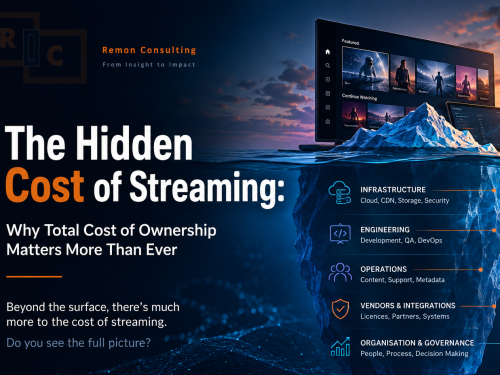
The platform licence is often the most visible cost. Much like the tip of an iceberg, a large part of the true cost sits below the surface.
Looking Beyond the Licence Fee
Streaming TCO is sometimes treated as a procurement exercise: compare the licence fees, negotiate the contract and select the most commercially attractive option. That is too narrow.
From a CFO’s perspective, the real question is not only what the technology costs to buy. It is what the business will need to spend to implement it, operate it, support it and continue developing it over several years.
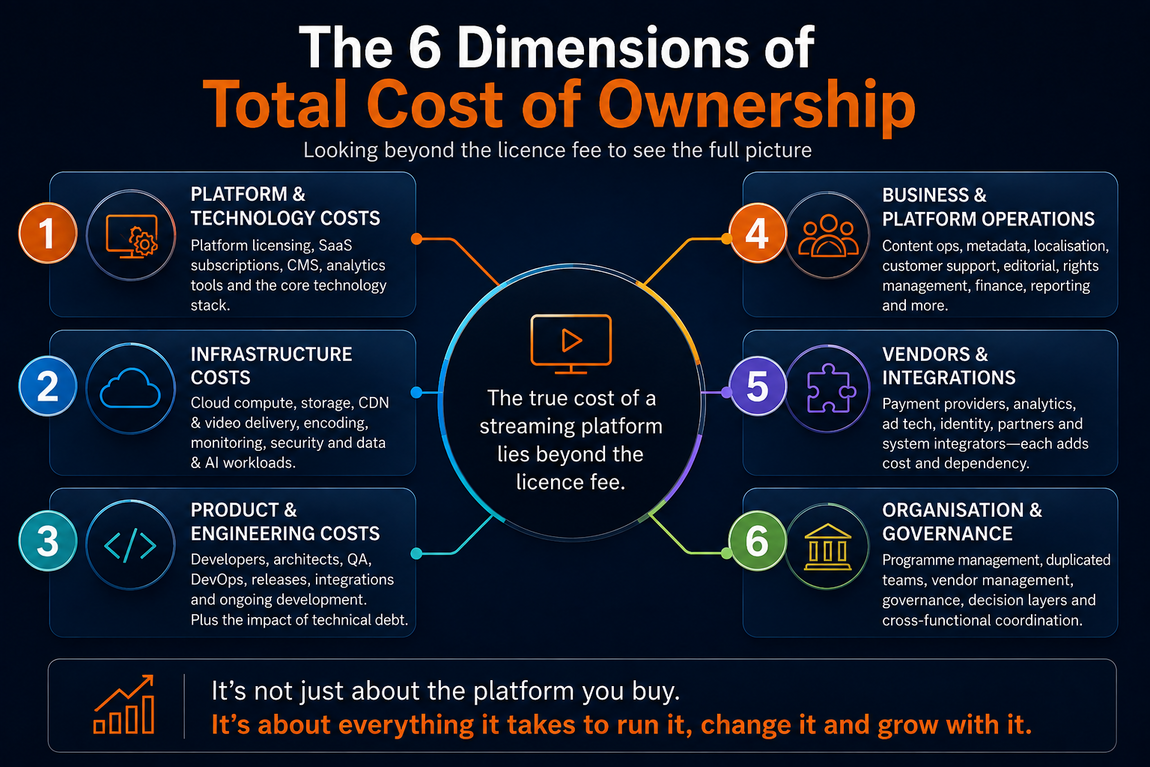
I tend to think about this across six areas.
1. Platform and technology
This is the most obvious category: platform licences, SaaS subscriptions, content management systems, analytics tools and the core technology stack.
Because these costs are visible and relatively easy to compare, they often dominate the commercial discussion. But I have seen lower licence costs offset by higher engineering, integration or operational costs elsewhere.
The cheapest contract is not always the cheapest solution.
2. Infrastructure
Streaming at scale requires cloud compute, storage, CDN and video delivery, encoding, monitoring and security, alongside growing data and AI workloads.
A significant proportion of these costs is usage-driven. They move with viewing hours, audience growth, content volumes and product functionality.
That means they can be difficult to forecast and even harder to control unless the commercial model, platform architecture and operating assumptions are properly understood.
3. Product and engineering
This is where the cost picture often becomes less transparent.
Developers, architects, QA, DevOps, release management, integrations and ongoing product development all form part of the cost of ownership. Technical debt does too, even though it rarely appears as a separate line in the budget.
A highly customised platform may solve an immediate requirement, but it can also create years of maintenance work and dependency on specialist knowledge.
That cost tends to emerge gradually rather than at the point of purchase.
4. Business and platform operations
A streaming service is not operated by technology teams alone.
Content operations, metadata, localisation, editorial, customer support, rights management, finance, reporting and several other functions are needed to keep the service running.
These costs are often spread across different departments and budgets, which makes them easy to miss when looking at the platform in isolation. Individually, they may not appear material. Taken together, they often are.
5. Vendors and integrations
Most streaming platforms rely on a network of providers rather than one end-to-end vendor.
Payments, recommendations, analytics, advertising technology, identity management, systems integration and specialist services all add cost. They also add dependencies.
Every integration has to be built, tested, monitored and maintained. Every additional vendor brings another contract, commercial relationship and potential point of failure.
Complexity has a cost, even when it is not labelled as such.
6. Organisation and governance
This may be the least visible part of TCO, but in some organisations it is one of the most significant.
Programme management, duplicated teams, vendor oversight, governance meetings, unclear decision rights and cross-functional coordination all consume time and money.
I have seen situations where the technology itself was not the main problem. The bigger issue was the operating model around it: too many hand-offs, blurred accountability and slow decisions.
Those costs do not normally appear in the platform business case, but they directly affect how expensive the platform is to run and how quickly it can respond to the market.
This is why I believe the TCO discussion needs to go beyond:
“How much does the platform cost?”
The more useful question is:
“What does the whole organisation need to spend to operate it, change it and continue creating value from it?”
That is an important distinction. The cheapest platform to buy may still be the most expensive one to own.
AI Changes the TCO Equation
There is a reasonable expectation that AI will lower the cost of operating streaming services.
In some areas, it almost certainly will.
Metadata, localisation, customer service, testing, content operations, analytics and software development all contain activities that can be automated or significantly accelerated.
But I do not think it is as simple as removing people and reducing cost.
AI changes the shape of the cost base.
It introduces compute and inference costs, new data requirements, integration work, model management, security, governance and demand for specialist skills.
Some of those costs will also be consumption-based. That may make them more variable and potentially less predictable than the systems or teams they replace.
There is another practical issue. Early AI benefits often appear in one department, while the cost sits somewhere else. Product may see faster delivery, for example, while technology absorbs the infrastructure cost and finance struggles to connect the two.
That is why AI investments should not only be assessed as standalone business cases. We also need to ask what they do to the economics of the platform overall.
Do they remove activity, or simply move it?
Do they simplify the operating model, or introduce another layer of technology and governance?
And do they create sustainable value once implementation, integration and ongoing usage costs are included?
For me, that is where AI and TCO come together.
The aim should not be to deploy more AI for its own sake. It should be to create a streaming operation that can move faster, make better decisions and deliver more value without allowing complexity and cost to grow unchecked.
The Bigger Picture
Ultimately, TCO is about more than cost reduction. It is about understanding the economics of the choices we make and the trade-offs between capability, complexity, flexibility and cost.
As the streaming industry continues to evolve, the platforms that succeed will not necessarily be those with the most technology or the most features. They will be the ones that understand what genuinely creates value for their audiences and their businesses, and what it costs to deliver it.
For CFOs, that means getting much closer to the technology conversation. And for technology leaders, it means bringing the economics into that conversation much earlier.
Let’s Continue the Conversation at IBC
If your organisation is reviewing its streaming platform, considering new technology investment or trying to get a clearer view of its Total Cost of Ownership, I would be very happy to compare notes.
You can find Remon Consulting at IBC in Amsterdam from 11–14 September, or contact us through LinkedIn or our website.